
Midnight Ice Cream and Chips Weren’t Weak Willpower: Sleep Deprivation and Weight (A Serious One)
Fair warning: today’s post is longer than usual.
But it’s an important one for every mom and dad in the thick of it. Grab some chips and settle in.
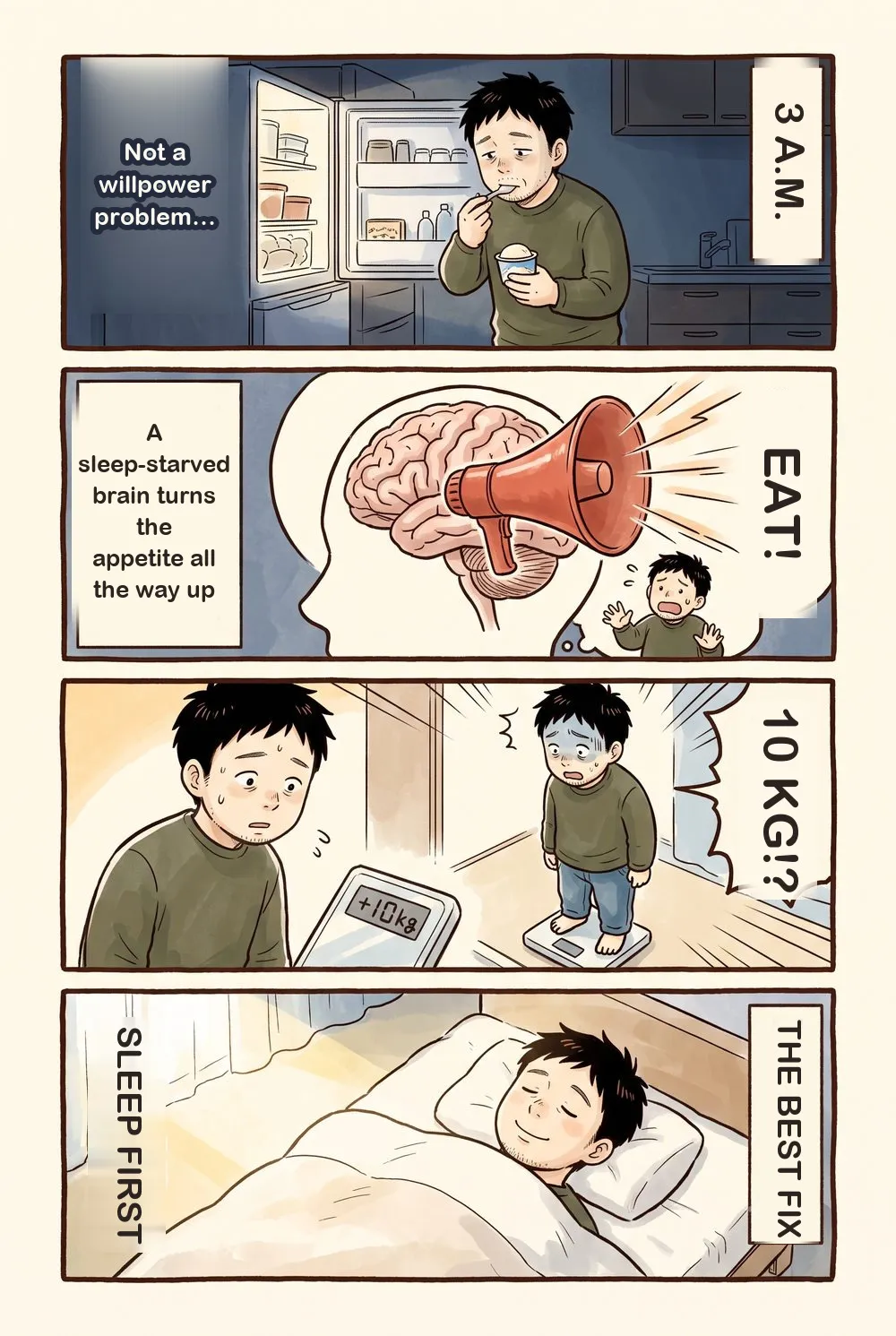
It all started with the bathroom scale. It read 10 kg (about 22 lbs) more than it used to.
I had my suspicions about the cause. There’s a man who, at 3 a.m., having just mixed a bottle and gotten the baby back to sleep, stands in front of the freezer eating ice cream. That man is me.
I assumed it was weak willpower. It wasn’t.
When I dug into it, it turns out “sleep deprivation makes you gain weight” is already firmly established science. And those of us raising babies are unwittingly re-creating the exact “sleep-deprived” experimental conditions, every single night.
Today I’ll share just three pieces of evidence. Every number comes from the papers linked at the end of this post. I’m a scientist, but not an expert on infants (my sources are).
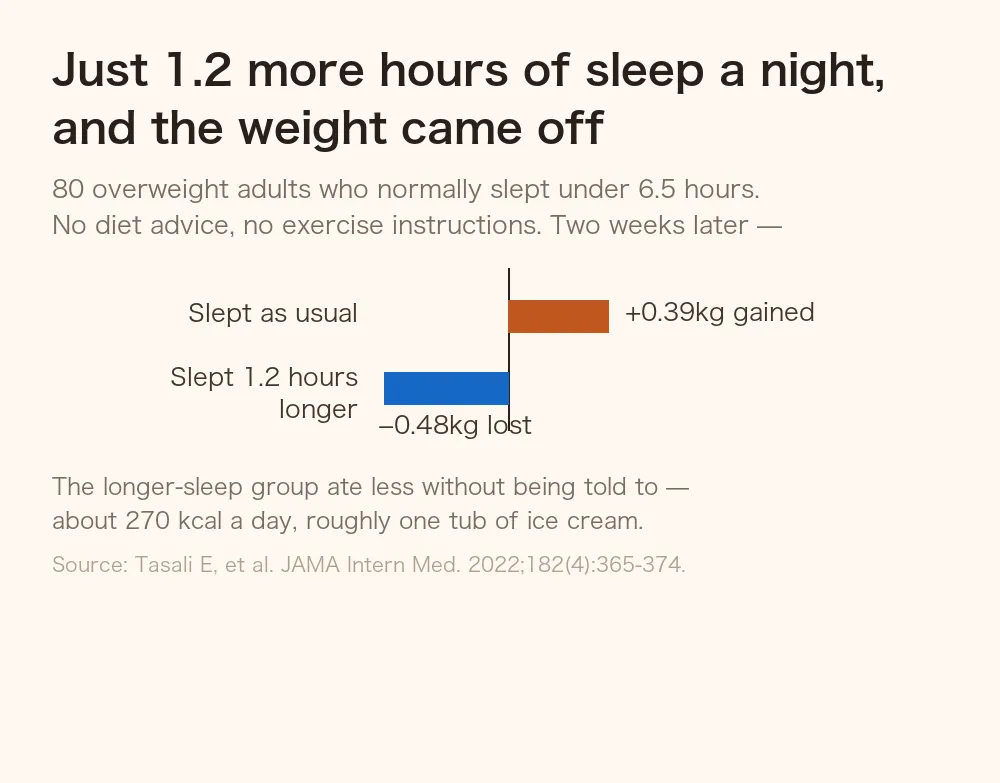
Evidence #1: Adding 1.2 hours of sleep made people eat less, all on its own
In 2022, JAMA Internal Medicine — a top-tier medical journal — published an experiment that went like this.
Take adults who normally sleep less than 6.5 hours a night, and have them extend their sleep by an average of 1.2 hours per day. That’s the whole intervention. No exercise instructions, no dietary coaching.
The result: in just two weeks, calorie intake dropped by about 270 kcal per day.
270 kcal is roughly one cup of ice cream. Just by sleeping, one ice cream’s worth of appetite vanished.
Flip that around, and it means those of us running on no sleep march into battle every day carrying one extra ice cream’s worth of appetite. Of course we lose.
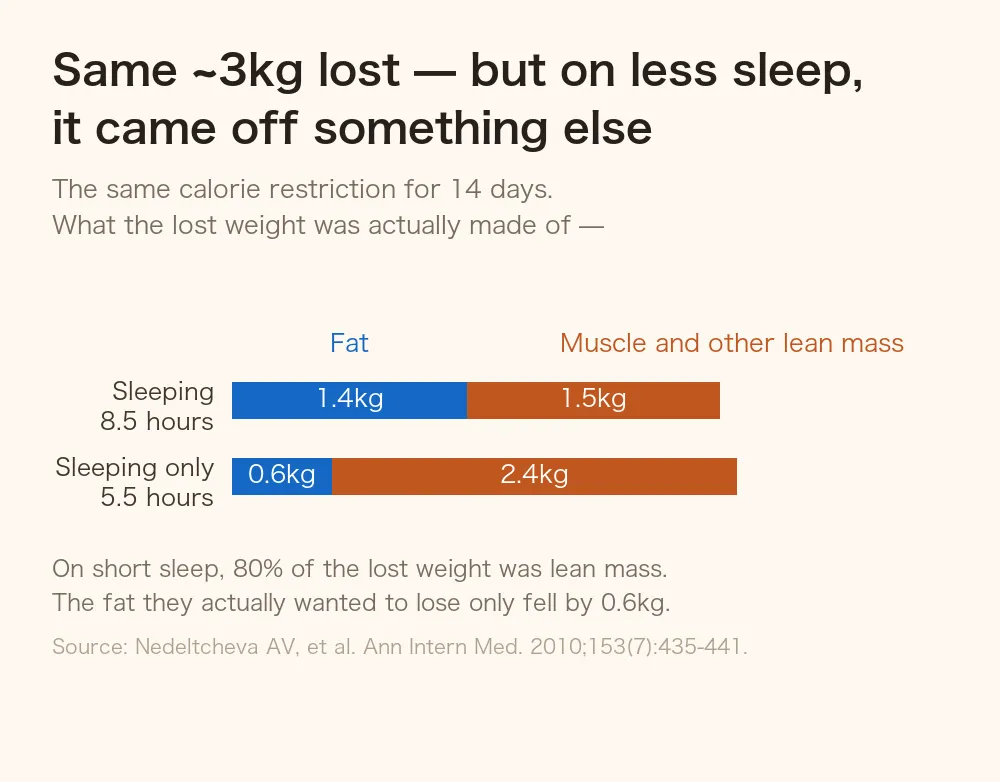
Evidence #2: Skimp on sleep, and you lose muscle instead of fat
There’s an even scarier study.
Two groups follow the same calorie-restricted diet; one group gets 8.5 hours in bed, the other only 5.5. Both groups lost about the same amount of weight.
But the contents were different. The short-sleep group lost hardly any fat — instead, more of what they lost was muscle.
In other words, diet while sleep-deprived and the thing you want gone stays, while the thing you want to keep disappears. Your body starts running like a warehouse with terrible inventory management.
Evidence #3: A sleep-deprived brain votes for sweets
When sleep is restricted to 4–5 hours in the lab, hunger increases — and cravings for sweet, fatty, and processed foods in particular get stronger. This has been confirmed again and again.
Sweet things. Fatty things. Ice cream and potato chips. My entire late-night starting lineup, called out by name in the literature.
The extra intake comes to 200–500 kcal per day. And much of it arrives as evening snacking.
The 3 a.m. ice cream was textbook behavior, straight out of the papers. It wasn’t my will that decided — it was my brain’s reward system casting the vote.
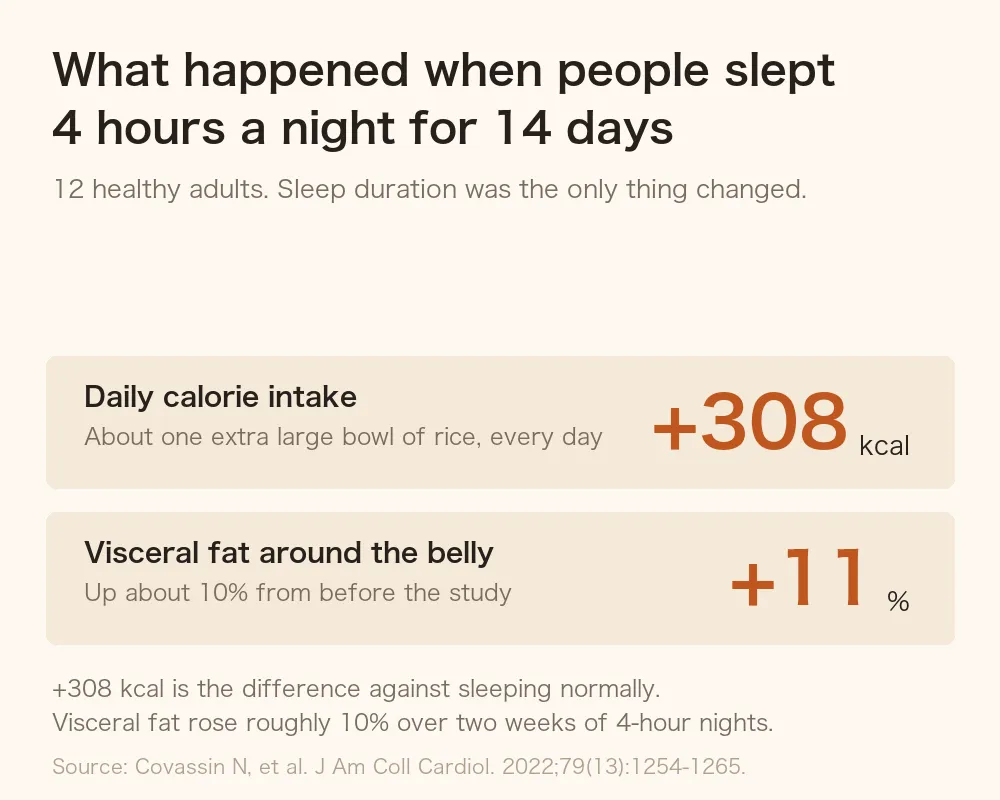
One more, while we’re at it: in an experiment where people slept 4 hours a night for 14 days, calorie intake rose by about 308 kcal — and visceral fat, the fat deep in the belly, increased. Of all the places to store it, that’s the worst one.
So what are we supposed to do?
The practical-takeaway section of these papers usually says something like: “Aim for 7–9 hours of sleep.”
I would like to deliver our baby to that researcher’s house for one night.
If I could sleep 7 hours straight, I wouldn’t be in this mess to begin with. During the baby years, sleep isn’t something you can increase by force of will. So today’s conclusion comes before any countermeasures — it’s simply what to know first.
- Gaining weight while raising a baby isn’t weak willpower — it’s physiology. Step one: stop blaming yourself.
- On days a chance to sleep appears, it’s okay to put sleep ahead of housework. That’s not laziness; it’s scientifically sound health management.
- If you can’t add sleep, your defensive line has to be drawn on the food side.
And this isn’t just a dad thing. My wife handles the overnight nursing, and she’s running an even deeper sleep deficit than I am.
That third point — the food-side defensive line — is what the next post is about: building meals around protein, iron for my breastfeeding wife, and nabe (Japanese hot pot), a marvel of civilization that barely requires a knife.

にじパパTRANSMISSION
In short: the 3 a.m. ice cream wasn’t my willpower losing. It was physiology being too strong.
Wrapping up
Sleep deprivation causes weight gain — that’s scientific fact. So the weight you put on while raising a baby is less a defeat of willpower and more of a built-in spec.
For the record, I’m writing this post in the middle of the night, as usual. Ice cream is standing by in the freezer, chips in the cupboard. Here’s hoping I put today’s learnings to use.
Studies referenced
- Randomized clinical trial in which extending sleep reduced calorie intake by about 270 kcal/day (JAMA Internal Medicine, 2022)
- Experiment in which sleep restriction increased calorie intake and visceral fat (JACC, 2022)
- Scoping review on sleep quantity, sleep quality, and weight loss (2024)
- Systematic review on sleep and the success of weight-loss interventions (2026)