No Honey, and Water at 70°C: Feeding a Baby Under One Has Surprisingly Few 'Absolutes'
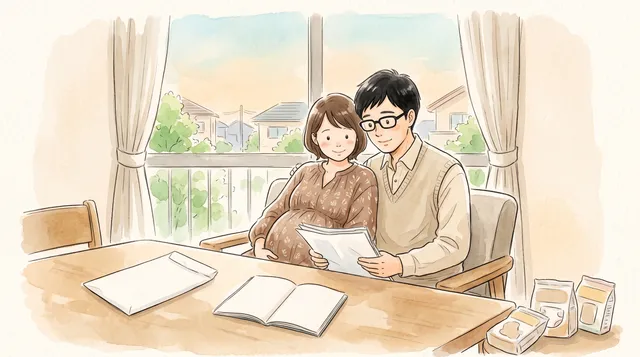
I spent twenty minutes frozen in front of the baby-food shelf at the supermarket.
Iron-fortified. Allergen-friendly. Organic. From 5 months. From 6 months.

にじパパTRANSMISSION
…So which one is the right answer?
Back home, I tried to look it up and promptly started drowning in a sea of information instead. So I dove down through the WHO, Japan's Ministry of Health, Labour and Welfare (MHLW), and even JECS, Japan's massive parent-and-child study, and came back up holding only the things you genuinely have to get right when feeding a baby in the first year.
The conclusion up front: the list of "absolutes" was astonishingly short.
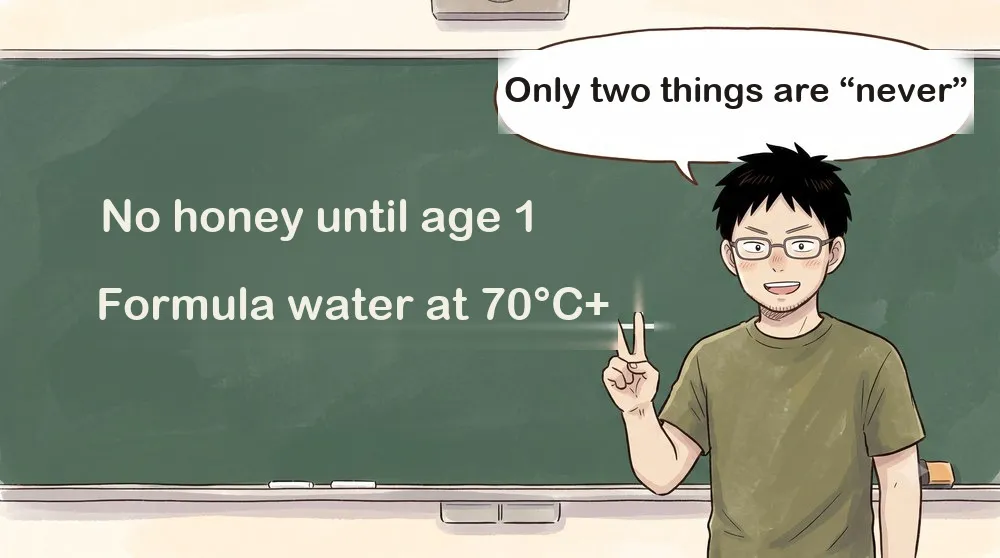
How many "absolute no's" are there, really?
At the level of official public-health guidance, the things with zero room for negotiation mainly came down to these two.
- Do not give honey to a baby under one year old (risk of infant botulism — and no, heating it doesn't make it safe).
- Prepare powdered formula with water at 70°C (158°F) or hotter, and throw away any prepared formula that hasn't been used within two hours.
Both are stated in black and white by Japan's Ministry of Health, Labour and Welfare (MHLW). Flip that around: keep these two rules, and most of everything else lives in the world of "recommendations."
Doesn't that take a little weight off your shoulders? It did mine.
Breast milk vs. formula: how does weight gain differ?
The WHO's principle is simple. Breast milk is optimal until around six months; start complementary foods at around six months while continuing to breastfeed. That is the baseline shared worldwide.
But in real life it's breast milk, formula, or some mix of the two — different for every family.
Here's where it gets interesting: a study out of Japan's JECS (the Japan Environment and Children's Study, a parent-child cohort of roughly 100,000 pairs). Babies fed mainly breast milk tended to surge early and then grow more gently from around 8–12 months onward, while mixed-fed and formula-fed babies started out slower and tended to catch up later.
In other words, the very "shape" of the growth curve differs by feeding method. Comparing your baby's weight at one single point against another child's, and feeling elated or crushed by it, doesn't mean much.
Wife: So… read the line, not the dot?
Apparently, yes. As for our own kid's "line," we'll have it read at the regular checkups.
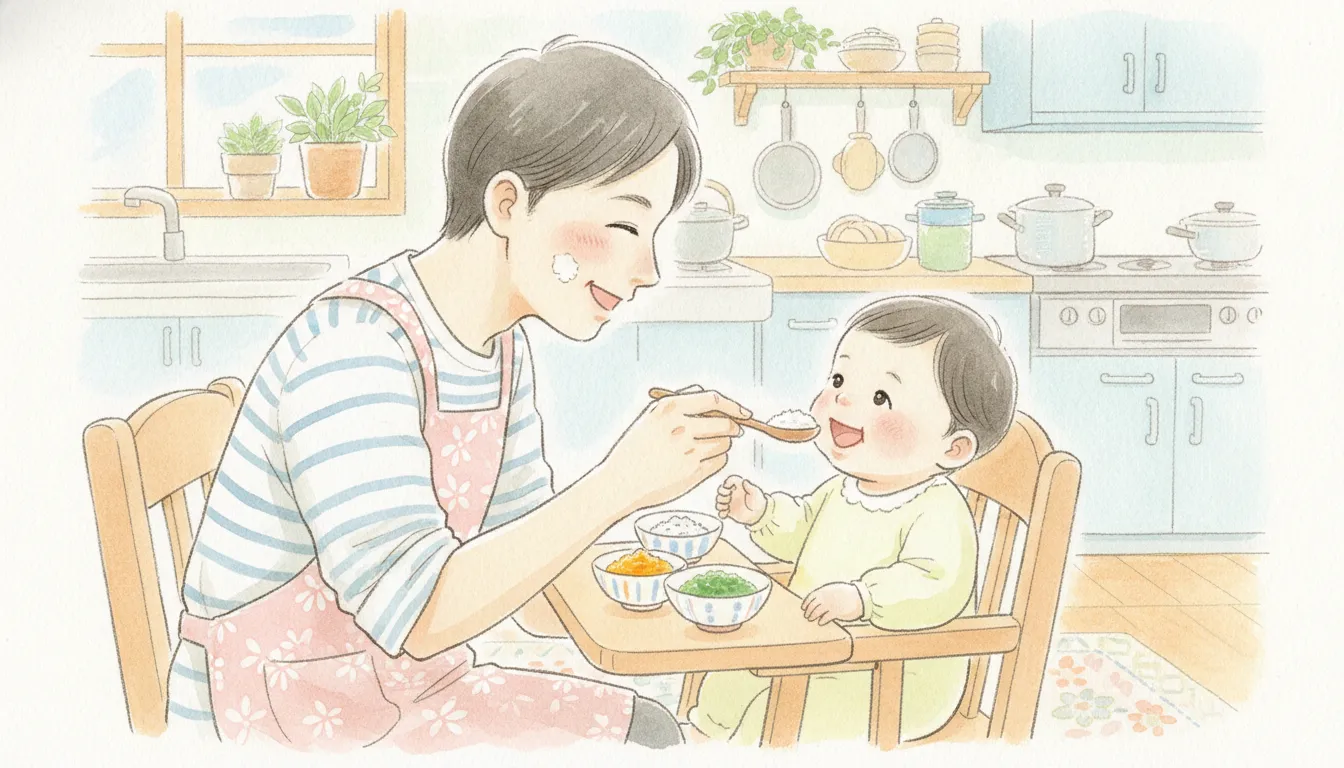
Incidentally, here is what mealtime looks like at our house.
Solids from six months: which nutrients run short first?
A study analyzing the diets of children aged 6–23 months in Asia listed iron, zinc, vitamin A, folate, vitamin B12, and calcium as the high-priority nutrients.
Iron above all. Past six months, breast milk alone gradually stops being enough.
I had been fixated on "when do we start?" — but in the research world, the main battleground is what you pack in, and how much (nutrient density). The watchword: don't let plain rice porridge be the thing that fills them up.
If solids aren't going well, is that parental laziness?
According to a review of studies on parents across Asia published in 2025, what shapes complementary-feeding practice is not knowledge alone.
Grandparents' opinions. The price of ingredients. Going back to work. How clearly health professionals explain things. Again and again, studies report that environmental factors like these drive what parents actually do.
Which means "we couldn't keep it up" does not equal "it's your fault." Using store-bought baby food isn't a white flag — it's strategy.
The Takeaway
Guard the honey rule and the 70°C rule with your life; for everything else, have your own child's "line" looked at during checkups.
Also, for the record: on the momentous first day of 10-to-1 okayu — rice porridge at its most watery, Japan's classic first food — the spoon set off on a journey toward the ceiling.
More from Nijipapa's "Evidence-Based Parenting" series
- All My 3 a.m. Searching Left Me Was Anxiety: A Reading Order for Parenting Information
- “Moisturize and They Won’t Get Allergies” Turned Out to Be Too Simple: Eczema and Food Allergies
- The Day I Closed the Parenting Book Without a Word: For Vaccine Schedules, Trust Today's Official Sources
- Browse the full "Evidence-Based Parenting" series
Note: This post is an introduction to published research and official guidance, and is not a substitute for diagnosis or treatment. For concerns specific to your child, please consult your pediatrician or bring them up at a well-baby checkup.
Main sources: WHO guideline on complementary feeding (2023); food-safety information from Japan's Ministry of Health, Labour and Welfare (MHLW) on honey and formula preparation; the Children and Families Agency's Maternal and Child Health Handbook information site; research on feeding methods and growth from JECS (the Japan Environment and Children's Study); a 2025 systematic review of complementary-feeding practices in Asia and micronutrient research from South/Southeast Asia. For more, see the WHO, MHLW, and the Children and Families Agency.