All My 3 a.m. Searching Left Me Was Anxiety: A Reading Order for Parenting Information
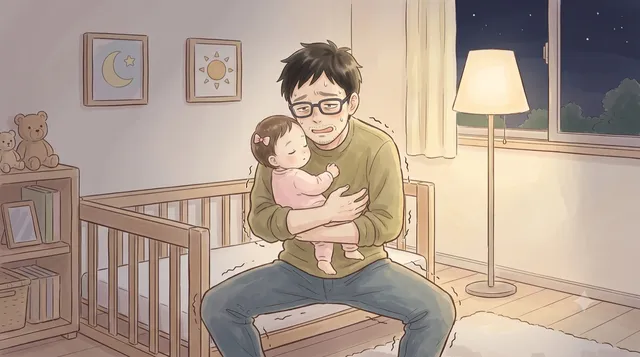
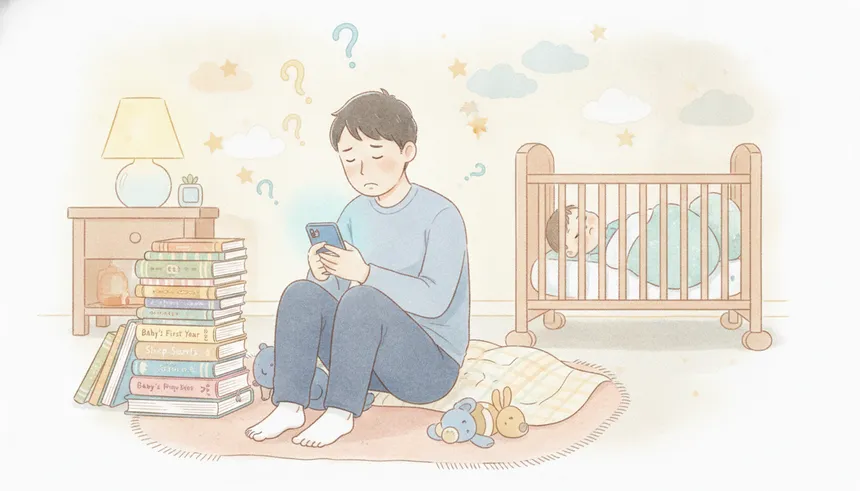
3 a.m. One hand patting the baby back to sleep, the other hand searching.
“when to start solids” “night crying how long” “baby eczema allergy”
An hour later, what I was left holding wasn’t knowledge. It was anxiety.
That stung enough that I decided to do the research properly, just once. I went through studies on infants in Asia and Japan, along with the WHO and AAP guidelines, and tried to sort it all out.
And here’s what I found: the problem was never the amount of information. It was the order.
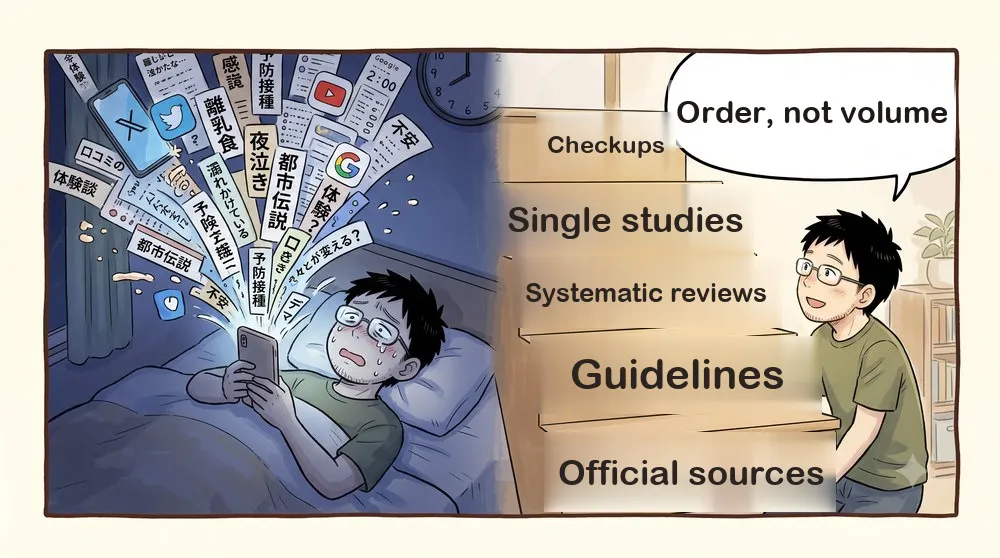
Why Does Searching in the Middle of the Night Leave You With Nothing but Anxiety?
The cause: I was reading completely different kinds of information all jumbled together.
Parenting information actually divides cleanly by role.
- Official resources (the Maternal and Child Health Handbook, the Children and Families Agency, Japan’s Ministry of Health, Labour and Welfare (MHLW), JIHS) — for deciding what to do today
- Guidelines (WHO, AAP, medical societies) — for getting the principles down
- Systematic reviews (Cochrane and the like) — for seeing the overall trend
- Cohort studies (JECS and others) — for checking how close the evidence is to your own situation
- Checkups and your regular pediatrician — for turning all of it into a conversation about your own child
The 3 a.m. version of me was reading all five with exactly the same weight. No wonder nothing ever got decided.
Flip that around and use them in this order, each for its own job, and you stop confusing “information for acting today” with “information for understanding the background.” That was the single most useful discovery of this whole exercise.
Which Resources Should You Check at Each Age?
Something else became clear along the way: the kind of resource you should reach for changes with your baby’s age.
| Age | Common questions | Check first |
|---|---|---|
| Up to 1 month | What to prepare, how to lay baby down to sleep, signs to watch for | Maternal and Child Health Handbook, parenting guide booklets |
| 1–2 months | Starting vaccinations, preparing formula | The JIHS vaccination schedule, MHLW food-safety information |
| 3–4 months | Weight gain, sleep, room-sharing and co-sleeping | Well-baby checkups, the AAP’s safe sleep recommendations |
| 5–6 months | Starting solids, iron deficiency, allergens | WHO complementary feeding guidelines, your pediatrician |
| 7–9 months | Hit-or-miss eating, eczema, injury prevention | Japan’s food allergy guidelines, injury-prevention resources |
| 10–12 months | Moving toward family meals, talking to your baby, development | WHO developmental guidelines, well-baby checkups |
I don’t think you need to do this perfectly. But once you can tell which step of the staircase today’s worry belongs to, the compulsive searching just stops.
What This Series Covers
I wrote up what I found in five posts. Every single one is a topic that caused an actual argument in our house.
- No Honey, and Water at 70°C: Feeding a Baby Under One Has Surprisingly Few 'Absolutes'
- The Day I Closed the Parenting Book Without a Word: For Vaccine Schedules, Trust Today's Official Sources
- It Never Said "Stop Co-Sleeping": Building a Safe Sleep Environment (A Serious One)
- “Moisturize and They Won’t Get Allergies” Turned Out to Be Too Simple: Eczema and Food Allergies
- Why Talk to Someone Who Can't Talk Back? The Answer From 102 Trials
For the record, the one that surprised me most was the allergy post. One thing I had believed got quietly dismantled.

にじパパTRANSMISSION
So, the moral: what I was short on wasn’t search time. It was a reading order.
Wrapping Up
With parenting information, piling on more volume just piles on more anxiety. Settling on an order made things surprisingly easier.
Incidentally, I am writing this post in the middle of the night. People never learn.
Note: This series is one dad’s attempt to organize what he learned from research papers and official resources; it is no substitute for diagnosis or treatment. Whenever you are unsure, always ask at your baby’s checkup or consult your regular pediatrician. Also, information tied to official programs, such as vaccinations, changes over time, so always check the latest official sources.
Main references: Children and Families Agency (Maternal and Child Health Handbook, checkups) · Japan’s Ministry of Health, Labour and Welfare (MHLW) (food safety, vaccinations) · WHO (complementary feeding, development) · AAP (safe sleep) · Cochrane · JECS.