“Moisturize and They Won’t Get Allergies” Turned Out to Be Too Simple: Eczema and Food Allergies

にじパパTRANSMISSION
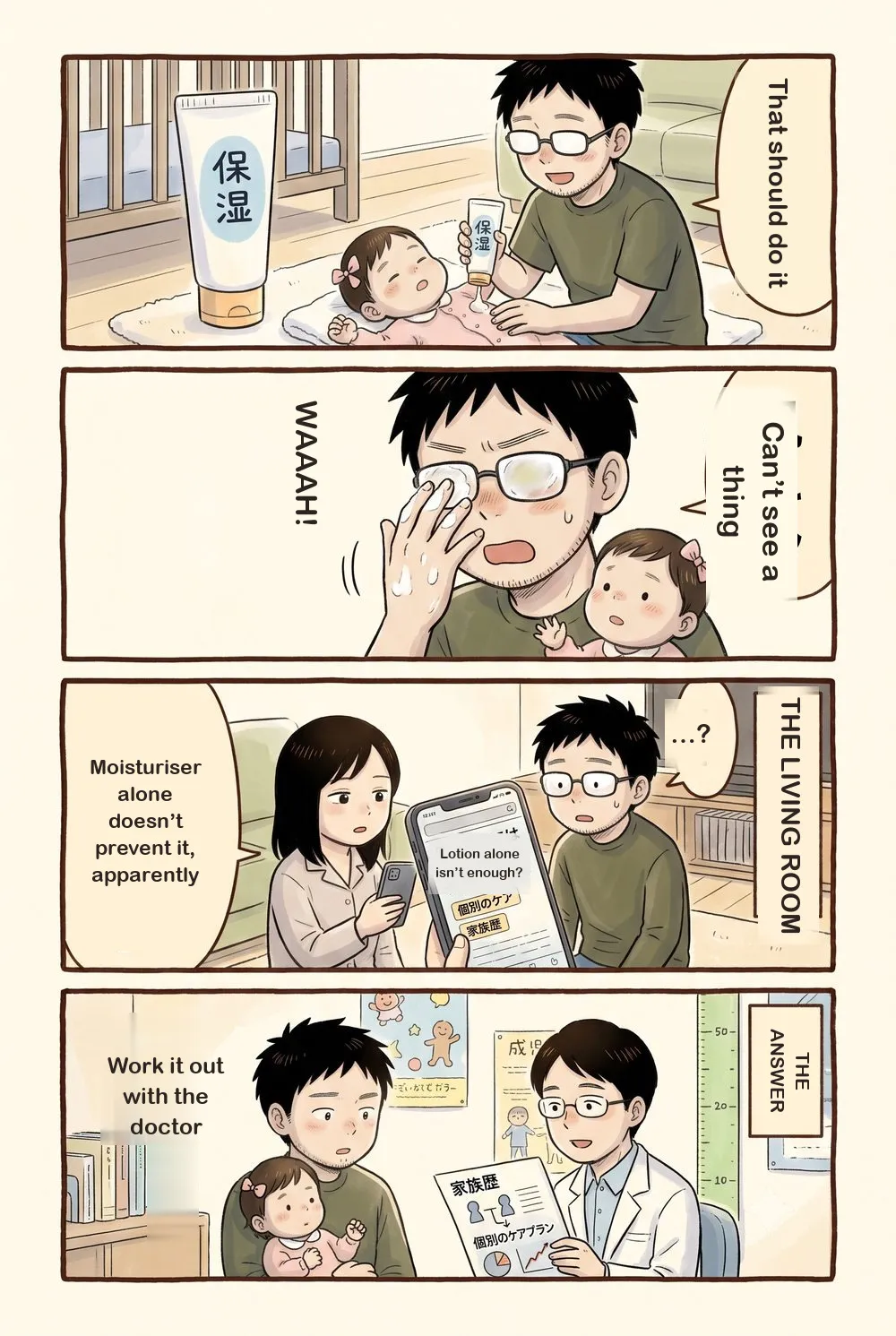
Apparently if you just keep them moisturized, they won’t get allergies.
I believed that for about six months.
So every day after the bath, I slathered it on and thought: allergy prevention, done.
Of everything I looked into for this post, this is where I gained the most. Honestly, one of my assumptions got demolished.
Does moisturizing prevent eczema?
This is the part I want you to read carefully.
A review by Cochrane (the international organization known for its systematic reviews) found that routinely applying moisturizer to healthy infants, by itself, can’t really be said to prevent eczema — and may even raise the risk of skin infections and food allergy.
But misreading this is dangerous in the opposite direction, so here is the line that matters.
- This finding is about applying moisturizer to every healthy, symptom-free baby purely for prevention
- It is absolutely not saying you can stop treatment or skincare for a child who already has eczema or atopic dermatitis
If anything, the field has moved toward treating eczema properly when it’s there. That’s exactly what the next section is about.
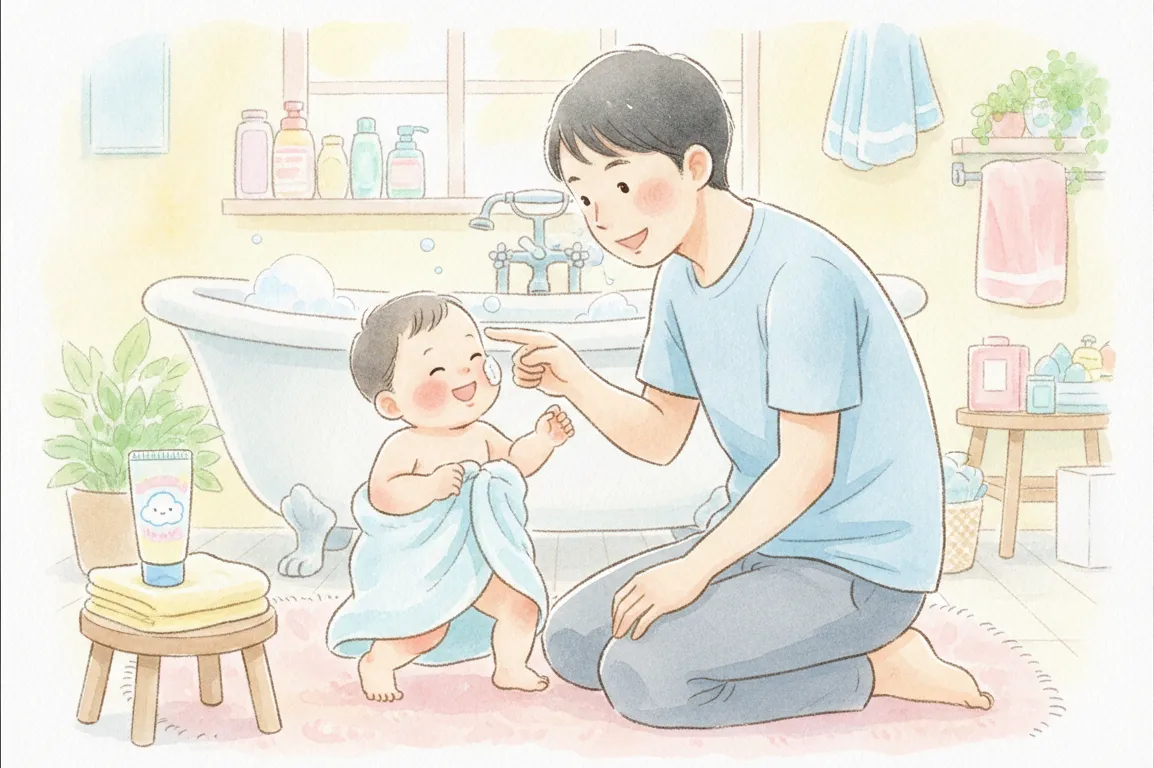
That said, I haven’t given up our post-bath ritual itself. It’s fun.
Are eczema and food allergies connected?
This turned out to be the heart of current thinking.
Because onset is so common in infancy, Japan’s clinical practice guidelines for food allergy treat food allergy linked to infant atopic dermatitis as a key concern. The keywords pushed to the front are “eczema,” “transcutaneous sensitization” (sensitization through the skin), and “early intervention.”
In other words: food components getting in through damaged skin can be what sets an allergy off.
In Japan’s JECS (the Japan Environment and Children’s Study, a nationwide study), too, eczema that started early and persisted was associated with increased risk in both areas: growth and food allergy.
So when you plan those first solid foods, the current playbook is apparently to treat the food side and the skin side as one problem. Leave the eczema alone and only fine-tune the menu, and you’ve covered exactly half of it.
Is it safer to introduce allergens later?
Apparently this is an area that has changed quite a bit over the past few years.
A 2025 review comparing East and West described not just early oral introduction, but continued intake afterward and active management of eczema as what matters. Not whether they ate it once — whether they can keep eating it.
On top of that, Japan’s guidelines emphasize proper evaluation using oral food challenges and avoiding complete elimination that isn’t necessary. Cutting out all egg on your own judgment points in exactly the wrong direction.
And here is the most important conclusion of this whole post: how and when to introduce allergens gets decided at the pediatrician’s office, not on the internet. Especially if there is already eczema, talk to the doctor first — always.
Wife: So where did those six months of confidence go?
Gone. And honestly, I’m glad it is.
Wrapping up
Not “moisturize and you’re covered.” Not “eliminate and you’re covered.” Skin and diet as a set, watched together with your pediatrician.
As for the moisturizer bottle, it is currently stored in our older kid’s toy box. I would like it back.
More from Nijipapa’s “Evidence-Based Parenting” series
- All My 3 a.m. Searching Left Me Was Anxiety: A Reading Order for Parenting Information
- No Honey, and Water at 70°C: Feeding a Baby Under One Has Surprisingly Few 'Absolutes'
- Why Talk to Someone Who Can't Talk Back? The Answer From 102 Trials
- Browse the full “Evidence-Based Parenting” series
Note: This post introduces research papers and guidelines; it is not a substitute for diagnosis or treatment. If you have any concerns about allergies, do not introduce or eliminate allergens on your own judgment — always consult a pediatrician or an allergy specialist. If your child is already being treated for eczema or atopic dermatitis, do not stop their care on your own.
Main sources: Food Allergy Clinical Practice Guidelines (Japan, 2020; updated 2021) / Cochrane systematic review of skin care interventions (2022) / “East meets West” review of food allergy prevention (2025) / JECS (Japan Environment and Children’s Study) research on eczema, growth, and food allergy.