It Never Said "Stop Co-Sleeping": Building a Safe Sleep Environment (A Serious One)

にじパパTRANSMISSION
So apparently it's dangerous for the baby to sleep in the same futon as us
When I said that, my wife went quiet.
Then, very calmly, this came back.
Wife: So when I'm up three times a night nursing, I'm supposed to get up every single time?
I had no comeback. I'd been waving correctness around without giving a second's thought to reality.
So I went back and did the reading. Bottom line: the guidelines never said "abandon your co-sleeping culture." They were saying something much more specific.
What does the global standard guideline actually say?
In the safe sleep guidance that the American Academy of Pediatrics (AAP) updated in 2022, these four points are emphasized as the core.
- Put the baby to sleep on their back (stomach sleeping is a risk factor)
- Use a firm, non-inclined sleep surface
- Keep soft bedding and objects out of the sleep area; don't let the baby overheat
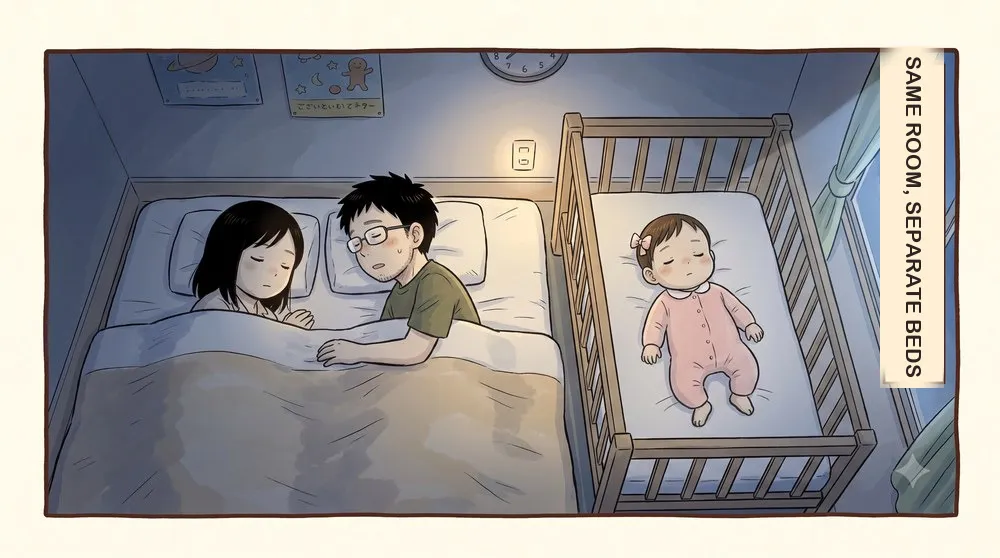
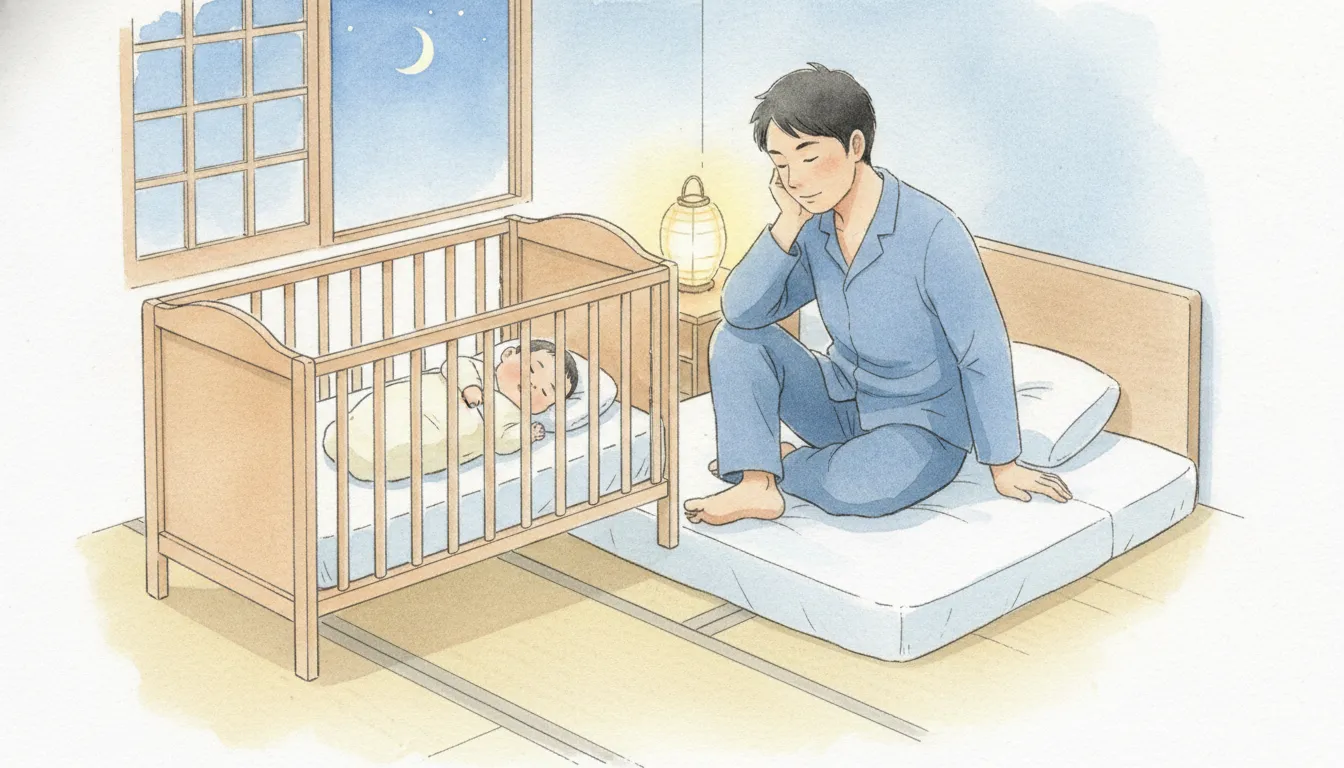
- Same room, separate sleep surface (room-sharing without bed-sharing)
On top of these, breastfeeding, not smoking, routine vaccinations, and a pacifier where appropriate are also treated as factors that lower risk.
The one that matters here is number four. Not "put the baby in a separate room" — "the same room, with just the sleep surface separate." The argument at our house had been built on misreading exactly that.
How well are Japanese households actually doing this?
This is where the numbers got pretty stark.
A Japanese study published in 2024 (a survey of infant caregivers in Yamaguchi Prefecture) reported that 96.0% were not fully practicing a safe sleep environment. And it wasn't that they had no knowledge at all.
They knew. They just weren't doing it.
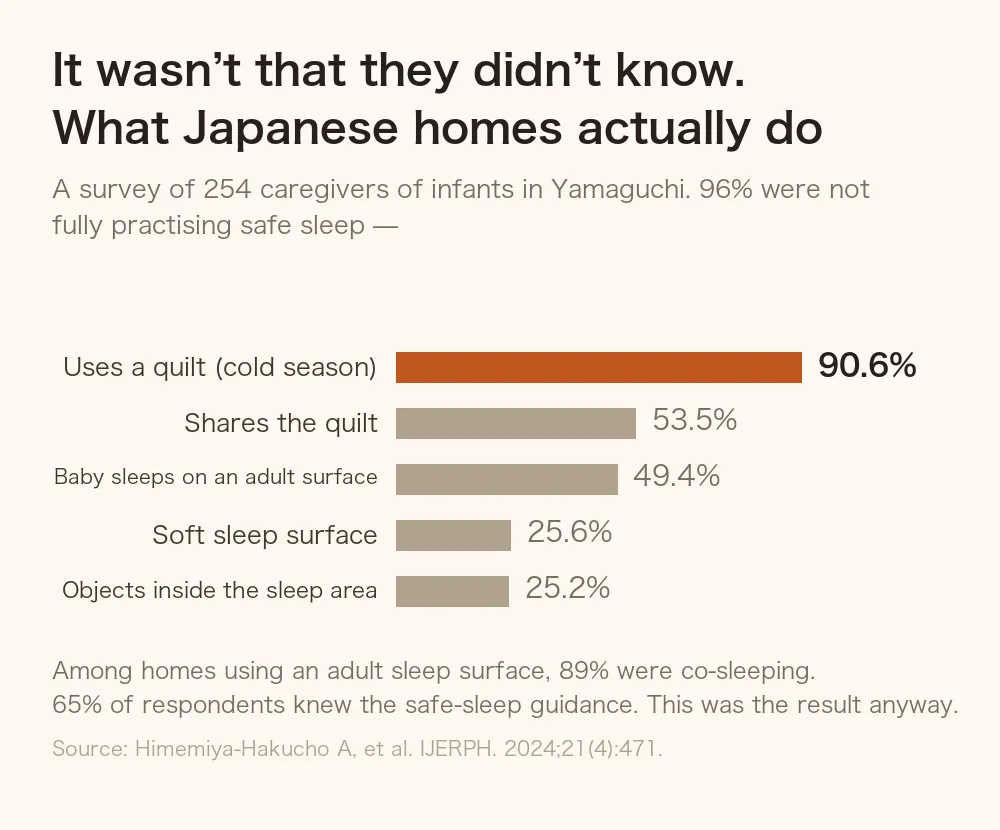
I recognized this picture. We had exactly one stuffed animal in the crib, too. Because it was cute.
Research comparing countries across Asia points the same way: later bedtimes, shorter total sleep, and more room-sharing. And older Japanese case-control research has likewise shown that stomach sleeping is a risk factor for SIDS (sudden infant death syndrome).
In other words, the Asian studies aren't saying the global-standard recommendations are "unnecessary." The accurate reading is that they're documenting the circumstances that make them hard to follow.
So how did we make it work at our house?
Rather than rejecting the culture, design the risk factors out. That, we concluded, was the most realistic path.
What we actually did is deeply unglamorous.
- Pulled the crib right up beside the parents' futon (within arm's reach, separate sleep surface)
- Stripped the inside of the crib down to just the sheet. The stuffed animal and the towel were escorted off the premises
- On the back, every single sleep. No overdressing
- Decided in advance where the baby goes down after a night feed, so that nobody just drifts off mid-hold
That last one is the hardest. On account of being sleepy.
One more thing: for judgment calls about your specific environment — how the bedding is set up, dozing off on the sofa, and so on — I really don't think you should improvise. The sure way is to describe your actual sleep arrangement at a checkup or to your pediatrician and have them look at it.
The Takeaway
The guidelines never came to condemn the way we live. All we had to carry home were the four things: on the back, a firm sleep surface, nothing in the bed, same room but separate beds.
As for the evicted stuffed animal — it now lives next to my pillow. Why.
More from Nijipapa's "Evidence-Based Parenting" series
- All My 3 a.m. Searching Left Me Was Anxiety: A Reading Order for Parenting Information
- The Day I Closed the Parenting Book Without a Word: For Vaccine Schedules, Trust Today's Official Sources
- The Night I Didn't Hear the Baby Cry
- Browse the full "Evidence-Based Parenting" series
Note: this post introduces published research and official resources; it is not a substitute for diagnosis or treatment. Sleep environments depend on your housing and household, so please discuss your actual sleep setup at a checkup or with your regular pediatrician.
Main sources: the AAP policy statement and technical report on safe sleep (2022 update); a cross-sectional study on safe infant sleep environment practices in Japan (2024); a multi-country comparison of infant and young-child sleep culture centered on Asia; Japanese case-control research on SIDS and stomach sleeping; and the Children and Families Agency's Maternal and Child Health Handbook information site. For more, see the Children and Families Agency and Japan's Ministry of Health, Labour and Welfare (MHLW).